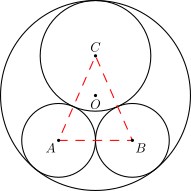
Two circles of radius $2$ and one circle of radius $3$ are externally tangent to each other and internally tangent to a larger circle. What is the radius of the large circle?
Let $A,B,C$ be the centers of the circles with radii $2,2,3$. Since the circles are mutually externally tangent, $AB=2+2=4$, $AC=BC=2+3=5$.
Place $A=(-2,0),B=(2,0)$; since $AC=BC=5$, $C=(0,\sqrt{21})$ (as $\sqrt{2^2+21}=5$).
Let $O=(0,k)$ be the big circle's center (by symmetry, $O$ lies on the perpendicular bisector of $AB$) and $R$ its radius. Internal tangency gives $OA=R-2$ and $OC=R-3$: $4+k^2=(R-2)^2$ and $(k-\sqrt{21})^2=(R-3)^2$.
Expanding the first equation: $k^2=R^2-4R$. Substituting into the expanded second equation and simplifying gives $\sqrt{21}\,k=R+6$, so $k=\dfrac{R+6}{\sqrt{21}}$.
Substituting back: $\left(\dfrac{R+6}{\sqrt{21}}\right)^2=R^2-4R$, which simplifies to $5R^2-24R-9=0$.
Solving: $R=\dfrac{24+\sqrt{576+180}}{10}=\dfrac{24+6\sqrt{21}}{10}=\dfrac{12+3\sqrt{21}}5$ (the other root is negative).
The answer is $\boxed{\dfrac{12+3\sqrt{21}}5}\approx5.150$.