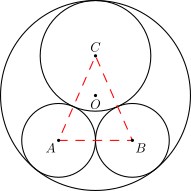
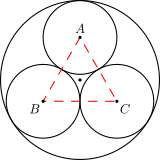
Three circles of radius $1$ are externally tangent to each other and internally tangent to a larger circle. What is the radius of the large circle? $\mathrm{(A) \ } \frac{2 + \sqrt{6}}{3} \qquad$ $ \mathrm{(B) \ } 2 \qquad$ $ \mathrm{(C) \ } \frac{2 + 3\sqrt{2}}{2} \qquad$ $ \mathrm{(D) \ } \frac{3 + 2\sqrt{3}}{3} \qquad$ $ \mathrm{(E) \ } \frac{3 + \sqrt{3}}{2}$
Solution
Let $A,B,C$ be the centers of the three small circles and $D$ the center of the large one. Connecting them, $AB=BC=CA=2$, and by symmetry $D$ is the center of equilateral $\triangle ABC$.
$AD$ is the circumradius of $\triangle ABC$: $AD=\frac23\cdot\frac{\sqrt3}2\cdot2=\frac{2\sqrt3}3$.
The large circle is centered at $D$, so its radius is $AD+1=1+\frac{2\sqrt3}3=\frac{3+2\sqrt3}3$.
Two circles of radius $2$ and one circle of radius $3$ are externally tangent to each other and internally tangent to a larger circle. What is the radius of the large circle?