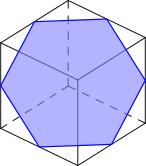
A cube with side length $1$ is sliced by a plane that passes through two diagonally opposite vertices $A$ and $C$ and the midpoints $B$ and $D$ of two opposite edges not containing $A$ or $C$, as shown. What is the area of quadrilateral $ABCD$? $\mathrm{(A)}\ \frac{\sqrt{6}}{2}\qquad$ $\mathrm{(B)}\ \frac{5}{4}\qquad$ $\mathrm{(C)}\ \sqrt{2}\qquad$ $\mathrm{(D)}\ \frac{5}{8}\qquad$ $\mathrm{(E)}\ \frac{3}{4}$
Solution
In a unit cube, take $A=(0,0,0)$, $C=(1,1,1)$, and $B=(1,0,\tfrac12)$, $D=(0,1,\tfrac12)$ as the two edge-midpoints.
Each side has length $\sqrt{1+0+\frac14}=\frac{\sqrt5}2$, so $ABCD$ is a rhombus. Its diagonals are $AC=\sqrt3$ and $BD=|(-1,1,0)|=\sqrt2$, so its area is $\frac12\sqrt3\cdot\sqrt2=\frac{\sqrt6}2$. The answer is (\textbf{A}).
A cube with side length $2$ is cut by a plane that passes through the midpoints of six of its edges (each of these edges avoids the two endpoints of one fixed space diagonal of the cube). What is the area of the hexagon formed by the cut?