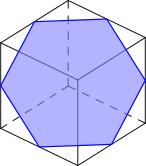
A cube with side length $2$ is cut by a plane that passes through the midpoints of six of its edges (each of these edges avoids the two endpoints of one fixed space diagonal of the cube). What is the area of the hexagon formed by the cut?
Let the cube be $[0,2]^3$ and the space diagonal run from $(0,0,0)$ to $(2,2,2)$. The six edges that avoid both endpoints have midpoints such as $(2,1,0),(1,2,0),(0,2,1),(0,1,2),(1,0,2),(2,0,1)$; all of them lie in the plane $x+y+z=3$.
Consecutive midpoints are joined by a segment across a face, for example from $(2,1,0)$ to $(1,2,0)$; its length is $\sqrt{1^2+1^2}=\sqrt2$. So the hexagon has six equal sides $\sqrt2$, and all its angles are equal by symmetry: it is regular.
A regular hexagon of side $\sqrt2$ has area $\dfrac{3\sqrt3}2(\sqrt2)^2=\boxed{3\sqrt3}$.