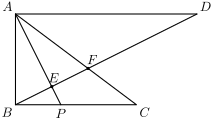
Let $\triangle ABC$ be a scalene triangle. Point $P$ lies on $\overline{BC}$ so that $\overline{AP}$ bisects $\angle BAC.$ The line through $B$ perpendicular to $\overline{AP}$ intersects the line through $A$ parallel to $\overline{BC}$ at point $D.$ Suppose $BP=2$ and $PC=3.$ What is $AD?$ $\textbf{(A) } 8 \qquad$ $ \textbf{(B) } 9 \qquad$ $ \textbf{(C) } 10 \qquad$ $ \textbf{(D) } 11 \qquad$ $ \textbf{(E) } 12$
Solution
Let $BD$ meet $AP$ at $E$ and $AC$ at $F$. Triangles $ABE$ and $AFE$ share $AE$, have right angles at $E$, and $\angle BAE=\angle FAE$, so $\triangle ABE\cong\triangle AFE$ (ASA) and $AF=AB$.
By angle bisector theorem (theorem 8), we get $AB:AC=BP:CP=2:3$, so $AF:AC=2:3$, hence $AF:FC=2:1$.
Since $AD\parallel BC$, $\triangle ADF\sim \triangle CBF$, so $AD:BC=AF:FC=2:1$. With $BC=BP+PC=5$, $AD=10$.
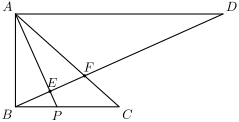
Let $\triangle ABC$ be a scalene triangle. Point $P$ lies on $\overline{BC}$ so that $\overline{AP}$ bisects $\angle BAC.$ The line through $B$ perpendicular to $\overline{AP}$ intersects the line through $A$ parallel to $\overline{BC}$ at point $D.$ Suppose $BP=3$ and $PC=5.$ What is $AD?$