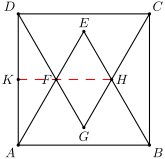
Two equilateral triangles are contained in a square whose side length is $2\sqrt 3$. The bases of these triangles are the opposite sides of the square, and their intersection is a rhombus. What is the area of the rhombus? $\text{(A) } \frac{3}{2} \qquad$ $ \text{(B) } \sqrt 3 \qquad$ $ \text{(C) } 2\sqrt 2 - 1 \qquad$ $ \text{(D) } 8\sqrt 3 - 12 \qquad$ $ \text{(E)} \frac{4\sqrt 3}{3}$
Solution
Connect $FH$ to meet $AD$ at $K$.
By symmetry $FH$ is horizontal at half the height of the square, so $AK=\sqrt3$. $F$ lies on $AE$, which makes $60^\circ$ with $AB$, so $AF=2$; and $AE=2\sqrt3$, so $EF=2\sqrt3-2$.
$\triangle EFH$ is equilateral (its angle at $E$ is $60^\circ$ and $EF=EH$), so $[EFH]=\frac{\sqrt3}4 (2\sqrt3-2)^2=4\sqrt3-6$.
The rhombus consists of two such triangles: $[EFGH]=8\sqrt3-12$.
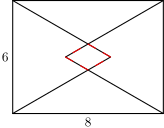
Two equilateral triangles of side length $6$ centimeters are placed inside an $8$-by-$6$-centimeter rectangle. A side of each triangle coincides with one of the rectangle's opposite $6$-centimeter sides. What is the area of the triangles' intersection?