Sign in
← Problem 121: (2007 AMC 12b, 22) →
Search
Go to
Problem 121: (2007 AMC 12b, 22)
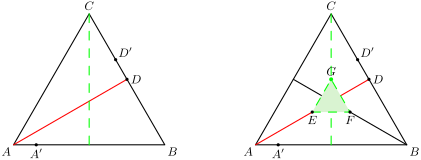
Two particles move along the edges of equilateral $\triangle ABC$ in the direction\[A\Rightarrow B\Rightarrow C\Rightarrow A,\]starting simultaneously and moving at the same speed. One starts at $A$, and the other starts at the midpoint of $\overline{BC}$. The midpoint of the line segment joining the two particles traces out a path that encloses a region $R$. What is the ratio of the area of $R$ to the area of $\triangle ABC$? $\mathrm {(A)} \frac{1}{16}\qquad$ $ \mathrm {(B)} \frac{1}{12}\qquad$ $ \mathrm {(C)} \frac{1}{9}\qquad$ $ \mathrm {(D)} \frac{1}{6}\qquad$ $ \mathrm {(E)} \frac{1}{4}$

Solution
Exercise 121: Solution
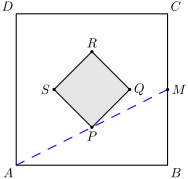
Two particles move at the same speed along the edges of square $ABCD$ in the direction $A\Rightarrow B\Rightarrow C\Rightarrow D\Rightarrow A$. At the start, one particle is at $A$ and the other is at the midpoint $M$ of $\overline{BC}$, so their initial segment is $\overline{AM}$. What is the ratio of the area enclosed by the path traced by the midpoint of the segment joining the particles to the area of square $ABCD$?
Search Go to Prev      Next

Contact Us

Thanks! Your message has been sent.