Sign in
← Exercise 121 →
Search
Go to
Exercise 121
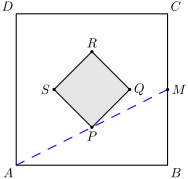
Two particles move at the same speed along the edges of square $ABCD$ in the direction $A\Rightarrow B\Rightarrow C\Rightarrow D\Rightarrow A$. At the start, one particle is at $A$ and the other is at the midpoint $M$ of $\overline{BC}$, so their initial segment is $\overline{AM}$. What is the ratio of the area enclosed by the path traced by the midpoint of the segment joining the particles to the area of square $ABCD$?
← Back to Problem 121
Solution
  1. Let the square have side $s$, with $A=(0,0)$, $B=(s,0)$, $C=(s,s)$, $D=(0,s)$. While the first particle goes from $A$ to the midpoint of $AB$, the second goes from $M=\left(s,\frac s2\right)$ to $C$, so the midpoint moves along a segment from $\left(\frac s2,\frac s4\right)$ to $\left(\frac{3s}4,\frac s2\right)$. During the next half side, the particles are at $(t,0)$ and $\left(\frac{3s}2-t,s\right)$, and their midpoint stays at $\left(\frac{3s}4,\frac s2\right)$. By symmetry the pattern repeats, so the midpoint traces a diamond with vertices $\left(\frac{s}{2},\frac{s}{4}\right)$, $\left(\frac{3s}{4},\frac{s}{2}\right)$, $\left(\frac{s}{2},\frac{3s}{4}\right)$, and $\left(\frac{s}{4},\frac{s}{2}\right)$.
  2. The diamond's diagonals each have length $\frac{s}{2}$, so its area is $\frac12(\frac{s}{2})^2=\frac{s^2}{8}$.
  3. The ratio of the enclosed area to the square's area is $\boxed{\frac18}$.
Search Go to Prev      Next

Contact Us

Thanks! Your message has been sent.
