Sign in
← Exercise 218 →
Search
Go to
Exercise 218
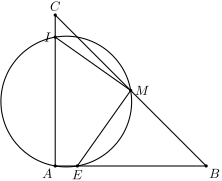
Triangle $ABC$ is an isosceles right triangle with $AB=AC=4$. $M$ is the midpoint of $\overline{BC}$; $I,E$ lie on $\overline{AC},\overline{AB}$ so that $AI>AE$ and $AIME$ is cyclic. Given $[EMI]=3$, $CI=a-\sqrt b$ for positive integers $a,b$. What is $a+b$?
← Back to Problem 218
Solution
  1. $\angle MIE=\angle MAE=45^\circ$ makes $\triangle MIE$ isosceles right, so $MI=ME=\sqrt{2\cdot3}=\sqrt6$.
  2. With $CI=x$: $MI^2=x^2+(2\sqrt2)^2-2x(2\sqrt2)\left(\frac{\sqrt2}2\right)$, i.e.\ $6=x^2+8-4x$, so $x^2-4x+2=0$, $x=2\pm\sqrt2$ by the quadratic formula. The rotation by $90^\circ$ about $M$ that takes $C$ to $A$ takes $I$ to $E$, so $AE=CI=x$, and $AI>AE$ means $4-x>x$, i.e. $x<2$. So $x=2-\sqrt2$.
  3. $a=2,b=2$: $a+b=\boxed4$.
Search Go to Prev      Next

Contact Us

Thanks! Your message has been sent.
