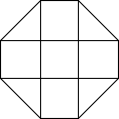
An equiangular octagon has four sides of length 1 and four sides of length $\sqrt{2}$, arranged so that no two consecutive sides have the same length. What is the area of the octagon? $\mathrm{(A) \ } \frac72\qquad$ $ \mathrm{(B) \ } \frac{7\sqrt2}{2}\qquad$ $ \mathrm{(C) \ } \frac{5+4\sqrt2}{2}\qquad$ $ \mathrm{(D) \ } \frac{4+5\sqrt2}{2}\qquad$ $ \mathrm{(E) \ } 7$
Solution
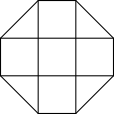
All angles are $135^\circ$, so extending the four sides of length $1$ gives a square, and each side of length $\sqrt2$ cuts off an isosceles right triangle with legs $1$ at a corner.
The square has side $1+1+1=3$, so the octagon has area $9-4\cdot\frac12=7$.
An equiangular octagon has four sides of length $2$ and four sides of length $3$, arranged so that no two consecutive sides have the same length. What is the area of the octagon?