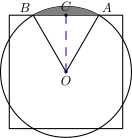
A square of side length $1$ and a circle of radius $\dfrac{\sqrt{3}}{3}$ share the same center. What is the area inside the circle, but outside the square? $\textbf{(A)}\ \dfrac{\pi}{3}-1 \qquad$ $ \textbf{(B)}\ \dfrac{2\pi}{9}-\dfrac{\sqrt{3}}{3} \qquad$ $ \textbf{(C)}\ \dfrac{\pi}{18} \qquad$ $ \textbf{(D)}\ \dfrac{1}{4} \qquad$ $ \textbf{(E)}\ \dfrac{2\pi}{9}$
Solution
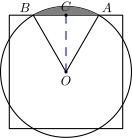
The circle crosses each side of the square. For one side, let $C$ be its midpoint and $A$ a point where the circle meets it. Then $OC=\frac12$ and $OA=\frac1{\sqrt3}$, so $\cos\angle AOC=\frac{\sqrt3}2$ and $\angle AOC=30^\circ$; the chord cut off by the side subtends $60^\circ$ at $O$.
The part of the circle beyond this side is a $60^\circ$ sector minus an equilateral triangle of side $\frac1{\sqrt3}$: $\frac16\cdot \pi\cdot \frac13-\frac{\sqrt3}4\cdot \frac13=\frac1{18}\pi-\frac{\sqrt3}{12}$.
So the answer = $4(\frac1{18}\pi-\frac{\sqrt3}{12})=\frac{2\pi}9-\frac{\sqrt3}3$.
A square of side length $2$ and a circle of radius $\dfrac{2\sqrt3}3$ share the same center. What is the area inside the circle but outside the square?