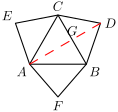
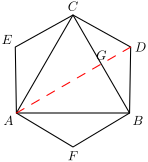
Three congruent isosceles triangles are constructed with their bases on the sides of an equilateral triangle of side length $1$. The sum of the areas of the three isosceles triangles is the same as the area of the equilateral triangle. What is the length of one of the two congruent sides of one of the isosceles triangles? $\textbf{(A) }\dfrac{\sqrt3}4\qquad$ $ \textbf{(B) }\dfrac{\sqrt3}3\qquad$ $ \textbf{(C) }\dfrac23\qquad$ $ \textbf{(D) }\dfrac{\sqrt2}2\qquad$ $ \textbf{(E) }\dfrac{\sqrt3}2$
Solution
Each isosceles triangle has the same base as the equilateral triangle and one third of its area, so its height is one third of the height of the equilateral triangle. With $G$ the midpoint of $BC$ and $D$ the apex on $BC$, $DG=\frac13 AG=\frac13\cdot\frac{\sqrt3}2=\frac{\sqrt3}6$.
Three congruent isosceles triangles are constructed outward with their bases on the sides of an equilateral triangle of side length $1$. The sum of their areas is twice the area of the equilateral triangle. What is the length of one of the two congruent sides of an isosceles triangle?