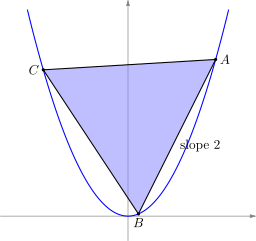
For two points $(u,u^2)$ and $(v,v^2)$ of the parabola, the slope of the chord is $\frac{u^2-v^2}{u-v}=u+v$. So if the vertices have $x$-coordinates $x_1,x_2,x_3$, the three sides have slopes $x_1+x_2,\ x_2+x_3,\ x_3+x_1$, and the sum of these slopes is $2(x_1+x_2+x_3)$.
- In an equilateral triangle the sides make angles of $60^\circ$ with each other. If one side has slope $2=\tan\theta$, the other two sides have inclinations $\theta+60^\circ$ and $\theta-60^\circ$, i.e. slopes $\tan(\theta+60^\circ)=\dfrac{2+\sqrt3}{1-2\sqrt3}$ and $\tan(\theta-60^\circ)=\dfrac{2-\sqrt3}{1+2\sqrt3}$.
- Their sum is $\dfrac{(2+\sqrt3)(1+2\sqrt3)+(2-\sqrt3)(1-2\sqrt3)}{(1-2\sqrt3)(1+2\sqrt3)}=\dfrac{16}{-11}$.
- The sum of the three slopes is $2-\frac{16}{11}=\frac6{11}$, so $x_1+x_2+x_3=\frac3{11}$ and $m+n=3+11=\boxed{14}$.
- Answer is (A).

