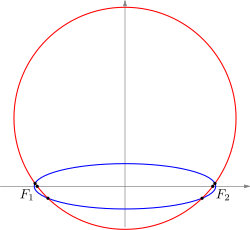
The ellipse $\frac{x^2}{16}+y^2=1$ has $a=4$, $b=1$, $c=\sqrt{16-1}=\sqrt{15}$, so its foci are $(\pm\sqrt{15},0)$. A circle through both foci has its center on the perpendicular bisector of the segment joining them, the $y$-axis: center $(0,k)$ and $r^2=k^2+15$.
- The circle is $x^2+y^2-2ky=15$ and the ellipse gives $x^2=16-16y^2$. Substituting, $16-16y^2+y^2-2ky=15$, i.e. $15y^2+2ky-1=0$, with roots $y=\dfrac{-k\pm r}{15}$. The product of the roots is $-\frac1{15}<0$, so one root is positive and one is negative.
- A point of the ellipse has $|y|\le1$. A root with $|y|<1$ gives two intersection points $(\pm x,y)$; a root with $|y|=1$ gives only one. So there are exactly four intersection points when both roots satisfy $|y|<1$.
- For $k\ge0$ the positive root is $\frac{r-k}{15}<1$ automatically. The negative root has $|y|=\frac{r+k}{15}<1$ exactly when $r<15-k$, i.e. $k^2+15<225-30k+k^2$, i.e. $k<7$. By symmetry the condition is $|k|<7$.
- Hence $r=\sqrt{k^2+15}$ takes all values in $[\sqrt{15},\sqrt{49+15})=[\sqrt{15},8)$, and $a+b=\sqrt{15}+8$.
- Answer is (D).

