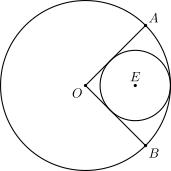
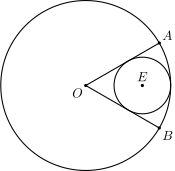
Points $A$ and $B$ lie on a circle centered at $O$, and $\angle AOB = 60^\circ$. A second circle is internally tangent to the first and tangent to both $\overline{OA}$ and $\overline{OB}$. What is the ratio of the area of the smaller circle to that of the larger circle? $\mathrm{(A)}\ \frac{1}{16}\qquad$ $\mathrm{(B)}\ \frac{1}{9}\qquad$ $\mathrm{(C)}\ \frac{1}{8}\qquad$ $\mathrm{(D)}\ \frac{1}{6}\qquad$ $\mathrm{(E)}\ \frac{1}{4}$
Solution
Let $E$ be the center of the small circle, $r$ its radius, and $C$ the point where it touches $OA$. $OE$ bisects $\angle AOB$, so $\angle EOC=30^\circ$ and $OE=2EC=2r$. The small circle is internally tangent to the big one, so $OA=OE+r=3r$.
Points $A,B$ lie on a circle centered at $O$, and $\angle AOB=90^\circ$. A second circle is internally tangent to the first and tangent to both $\overline{OA}$ and $\overline{OB}$. What is the ratio of the area of the smaller circle to the larger?