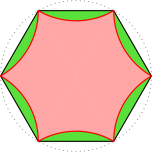
A regular hexagon of side length $1$ is inscribed in a circle. Each minor arc of the circle determined by a side of the hexagon is reflected over that side. What is the area of the region bounded by these $6$ reflected arcs? $(\textbf{A})\: \frac{5\sqrt{3}}{2} - \pi\qquad(\textbf{B}) \: 3\sqrt{3}-\pi\qquad(\textbf{C}) \: 4\sqrt{3}-\frac{3\pi}{2}\qquad(\textbf{D}) \: \pi - \frac{\sqrt{3}}{2}\qquad(\textbf{E}) \: \frac{\pi + \sqrt{3}}{2}$
Solution
The circle has radius $1$. The region is the hexagon minus six circular segments (each reflected arc cuts off from the hexagon a segment congruent to the one beyond the side), and it splits into six congruent pieces, one per side. The green segment of one side is a $60^\circ$ sector minus an equilateral triangle: $\frac16\pi-\frac{\sqrt3}4$. So the red piece for one side has area $=\frac{\sqrt3}4-(\frac16\pi-\frac{\sqrt3}4)=\frac{\sqrt3}2-\frac{\pi}6$.
The wanted area is $6(\frac{\sqrt3}2-\frac{\pi}6)=3\sqrt3-\pi$.
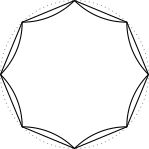
A regular octagon of side length $1$ is inscribed in a circle. Each minor arc of the circle determined by a side of the octagon is reflected over that side. What is the area of the region bounded by these $8$ reflected arcs?