Sign in
← Exercise 89 →
Search
Go to
Exercise 89
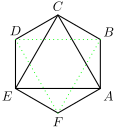
Let $ABCDEF$ be an equiangular hexagon. The lines $AB,CD,EF$ determine a triangle with area $48\sqrt3$, and the lines $BC,DE,FA$ determine a triangle with area $25\sqrt3$. The perimeter of hexagon $ABCDEF$ can be expressed as $m+n\sqrt p$, where $m,n,p$ are positive integers and $p$ is squarefree. What is $m+n+p$?
← Back to Problem 89
Solution
  1. An equilateral triangle of area $k\sqrt3$ has side $2\sqrt k$. So the triangle formed by lines $AB,CD,EF$ has side $2\sqrt{48}=8\sqrt3$, and the one formed by $BC,DE,FA$ has side $2\sqrt{25}=10$.
  2. As in the problem, with $a,\dots,f$ the sides of the hexagon, $a+b+f=b+c+d=d+e+f=8\sqrt3$ and $a+b+c=c+d+e=e+f+a=10$. Adding all six equations, $3(a+b+c+d+e+f)=3(8\sqrt3+10)$.
  3. Perimeter $=10+8\sqrt3$, so $m+n+p=10+8+3=\boxed{21}$.
Search Go to Prev      Next

Contact Us

Thanks! Your message has been sent.
