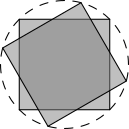
Let $\theta$ be the rotation angle in radians. In each $90^\circ$ sector about the center, the farthest radius is $s/\sqrt2$ over an angular interval of length $\theta$. On either side, at angular distance $u$ from this interval, the radius is $\frac{s}{2\cos(\pi/4-u)}$, where $0\le u\le\frac{\pi/2-\theta}{2}$.
So each quarter of the swept region consists of a sector of radius $\frac s{\sqrt2}$ and angle $\theta$ (area $\frac{s^2}4\theta$) and two triangles with apex at the center, height $\frac s2$, and base of length $\frac s2\left(1-\tan\frac\theta2\right)$ on a side line, each of area $\frac12\cdot\frac s2\left(\frac s2-\frac s2\tan\frac\theta2\right)=\frac{s^2}8\left(1-\tan\frac\theta2\right)$. By fourfold symmetry the swept area is $s^2\theta+s^2\left(1-\tan\frac\theta2\right)=s^2\left(\theta+1-\tan\frac\theta2\right)$. (For $s=1$, $\theta=\frac\pi4$ this gives $2-\sqrt2+\frac\pi4$, as in the problem.)
With $s=2$ and $\theta=\frac\pi6$, the area is $4\left(1+\frac\pi6-\tan\frac\pi{12}\right)=\boxed{4\sqrt3-4+\frac{2\pi}3}$.