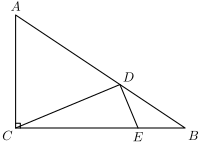
In $\triangle ABC$ with a right angle at $C$, point $D$ lies in the interior of $\overline{AB}$ and point $E$ lies in the interior of $\overline{BC}$ so that $AC=CD,$ $DE=EB,$ and the ratio $AC:DE=12:5$. What is the ratio $AD:DB?$
Since $AC=CD$, $\triangle CDA$ is isosceles and $\angle CDA=\angle A$; since $DE=EB$, $\triangle DBE$ is isosceles and $\angle EDB=\angle B$. So $\angle CDE=180^\circ-\angle CDA-\angle EDB=180^\circ-\angle A-\angle B=90^\circ$.
So $\triangle CDE$ is a right triangle with $DE:DC=5:12$, hence $DE:DC:CE=5:12:13$; we may assume $DE=5$, $CD=12$, $CE=13$.
Draw $DF\bot BC$. By theorem 7, $CF=\frac{CD^2}{CE}=\frac{144}{13}$ and $EF=\frac{DE^2}{CE}=\frac{25}{13}$.
$AC\parallel DF$ (both perpendicular to $BC$), so $AD:DB=CF:FB$.
$FB=FE+EB=FE+DE=\frac{25}{13}+5=\frac{90}{13}$, so $AD:DB=CF:FB=144:90=\boxed{8:5}$.