Sign in
← Exercise 279 →
Search
Go to
Exercise 279
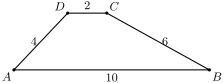
A trapezoid has side lengths $2$, $4$, $6$, and $10$. The sum of all its possible areas can be written as $r_1\sqrt{n_1}+r_2\sqrt{n_2}+r_3$, where $r_1,r_2,r_3$ are rational and $n_1,n_2$ are squarefree positive integers. What is the greatest integer less than or equal to $r_1+r_2+r_3+n_1+n_2$?
← Back to Problem 279
Solution
  1. As in the problem, the legs and the difference of the bases must form a triangle. Bases $(2,4),(2,6),(4,6)$ fail. Bases $(2,10)$: triangle $4,6,8$ with area $3\sqrt{15}$ and height $\frac{3\sqrt{15}}4$ to the side $8$, trapezoid area $6\cdot\frac{3\sqrt{15}}4=\frac{9\sqrt{15}}2$. Bases $(6,10)$: triangle $2,4,4$ with area $\sqrt{15}$ and height $\frac{\sqrt{15}}2$ to the side $4$, area $8\cdot\frac{\sqrt{15}}2=4\sqrt{15}$. Bases $(4,10)$: triangle $2,6,6$ with area $\sqrt{35}$ and height $\frac{\sqrt{35}}3$ to the side $6$, area $7\cdot\frac{\sqrt{35}}3=\frac{7\sqrt{35}}3$.
  2. Their sum is $\frac{17}2\sqrt{15}+\frac73\sqrt{35}$, so $r_1+r_2+r_3+n_1+n_2=\frac{17}2+\frac73+15+35=\frac{365}6$.
  3. The greatest integer less than or equal to this value is $\boxed{60}$.
Search Go to Prev      Next

Contact Us

Thanks! Your message has been sent.
