Sign in
← Exercise 250 →
Search
Go to
Exercise 250
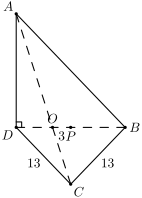
Trapezoid $ABCD$ has $\overline{AB} \parallel \overline{CD}$, $BC = CD = 13$, and $\overline{AD} \perp \overline{BD}$. Let $O$ be the intersection of the diagonals $\overline{AC}$ and $\overline{BD}$, and let $P$ be the midpoint of $\overline{BD}$. Given that $OP = 3$, the length $AD$ can be written in the form $m\sqrt{n}$, where $n$ is squarefree. What is $m + n$?
← Back to Problem 250
Solution
  1. Let $D=(0,0)$, $A=(0,a)$, and $B=(d,0)$. Write $r=CD/AB$. Since $CD\parallel AB$, $C=(rd,-ra)$. Using $BC=CD$ gives $d^2(1-r)^2+a^2r^2=r^2(d^2+a^2)$, hence $r=\frac12$ and $AB=2CD=26$. Thus $AD^2+BD^2=26^2$.
  2. The diagonals of a trapezoid divide each other in the ratio of the parallel sides, so $BO:OD=AB:CD=2:1$. If $BD=3x$, then $BO=2x$, $OD=x$, and the midpoint $P$ is $3x/2$ from $B$. Hence $OP=x/2=BD/6$, so $BD=6\cdot3=18$.
  3. Therefore,
    $$AD=\sqrt{26^2-18^2}=\sqrt{352}=4\sqrt{22},$$
    so $m+n=4+22=26$.
Search Go to Prev      Next

Contact Us

Thanks! Your message has been sent.
