Sign in
← Exercise 22 →
Search
Go to
Exercise 22
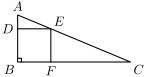
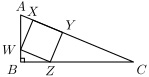
A square with side length $x$ is inscribed in a right triangle with sides of length $5$, $12$, and $13$ so that one vertex of the square coincides with the right-angle vertex of the triangle. A square with side length $y$ is inscribed in another right triangle with sides of length $5$, $12$, and $13$ so that one side of the square lies on the hypotenuse of the triangle. What is $\tfrac{x}{y}$? \begin{center} $\qquad$ \end{center}

← Back to Problem 22
Solution
  1. Let the legs be $a=5$, $b=12$ and the hypotenuse $c=13$.
  2. First square (vertex at the right angle): the small triangle cut off along leg $b$ is similar to the whole triangle, so $(b-x):x=b:a$, i.e. $x=\dfrac{ab}{a+b}=\dfrac{60}{17}$.
  3. Second square (side on the hypotenuse): the two corner triangles at the ends of the hypotenuse are similar to the whole triangle, and their sides along the hypotenuse are $y\cdot\frac ab$ and $y\cdot\frac ba$. So $c=y\left(\frac ab+1+\frac ba\right)$, i.e. $13=y\left(\frac5{12}+1+\frac{12}5\right)=\frac{229}{60}y$ and $y=\dfrac{780}{229}$.
  4. $\dfrac xy=\dfrac{60}{17}\cdot\dfrac{229}{780}=\boxed{\dfrac{229}{221}}$.
Search Go to Prev      Next

Contact Us

Thanks! Your message has been sent.