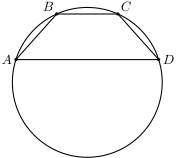
A quadrilateral $ABCD$ is inscribed in a circle of radius $3\sqrt6$. Three of its sides, $AB$, $BC$ and $CD$, have length $6$. What is the length of the fourth side $DA$?
Let $DA=x$. A cyclic quadrilateral with $AB=BC=CD=6$ is an isosceles trapezoid with $AD\parallel BC$, legs $AB=CD=6$ and bases $AD=x$, $BC=6$.
Drop the perpendicular $BH$ to $AD$. Then $AH=\dfrac{x-6}2$, so the height is $h=BH$ with $h^2=36-\left(\dfrac{x-6}2\right)^2$. In the right triangle $BHD$, $HD=\dfrac{x+6}2$, so the diagonal is $BD^2=\left(\dfrac{x+6}2\right)^2+h^2=36+6x$.
Triangle $ABD$ is inscribed in the same circle, so its circumradius is $3\sqrt6$. Its sides are $AB=6$, $AD=x$, $BD$, and its area is $\dfrac12xh$, so $3\sqrt6=\dfrac{AB\cdot AD\cdot BD}{4[ABD]}=\dfrac{6x\cdot BD}{2xh}=\dfrac{3\,BD}{h}$. Hence $BD=\sqrt6\,h$ and $BD^2=6h^2$.
Therefore $36+6x=6\left(36-\dfrac{(x-6)^2}4\right)$, which simplifies to $(x-6)^2=120-4x$, i.e. $x^2-8x-84=0$, or $(x-14)(x+6)=0$. Since $x>0$, the fourth side is $\boxed{14}$.